
All businesses have customers who buy once… then disappear. The goal, in order to drive growth, is to turn them into repeat customers and establish a consumption habit.
 In 5 steps, here’s exactly what you need to do:
1. The “3-Visit Rule”: The Tipping Point
There is a statistical threshold where a customer changes status in their own mind. A customer who returns for a third visit has a 70% to 80% chance of coming back a fourth time and settling into a consumption routine. Conversely, after just one visit, there is less than a 20% chance they will return on their own without any stimulation.
A repeat customer generates 3 to 10 times more profit over their “lifetime” than a one-time buyer.
As an entrepreneur, you must understand the customer journey and analyze purchasing habits to better target marketing actions that will trigger the desired behaviors.
2. Reducing Friction for the Second Purchase
The hardest part is not getting a customer in the first time, but getting them to come back quickly for a second visit.
The time between the first and second visit is the best predictor of future loyalty. The shorter this delay, the stronger the habit becomes.
You should therefore offer an immediate reward to encourage a quick return. For example, an offer like “Valid on your next visit within 15 days” increases the return rate by 40% compared to a standard discount with no time limit.
3. Personalization: The Engine of Consistency
An occasional customer feels “anonymous.” A repeat customer feels “recognized.”
You need to create a sense of belonging, because to maintain loyalty, customers must feel like they are part of a community.
Digital recognition (via smartphone) meets this psychological need for belonging, as it integrates into the customer’s habits and builds familiarity.
This is even more important considering that 70% of customers are more likely to become repeat buyers if the business uses their purchasing preferences to offer relevant deals.
4. The Impact of Digital Loyalty Card Systems
Technologies like LoylGo act as a constant reminder in the customer’s pocket.
The visibility of points balance or progress toward a reward creates an “endowment effect” (people don’t want to lose what they’ve started accumulating). It’s worth noting that members of loyalty programs spend on average 12% to 18% more per year than non-members.
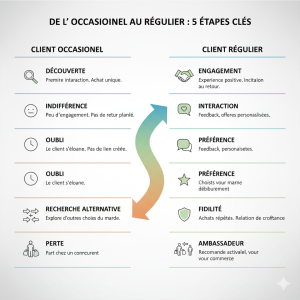 5. The Overall Customer Experience (CX)
Price attracts the occasional customer; experience retains the repeat customer.
In 2026, tolerance is minimal. A single friction point can break the transformation cycle.
In fact, 64% of consumers now rank the shopping experience above price as a loyalty driver.
Setting up a customer retention system through loyalty program management tools is not enough. You must also embed a culture of quality and excellence in service at every level—whether in production operations, in-store activities, or customer service.
Statistical Sources:
- Gartner et al., Zendesk Trend Reports 2026
- Accenture Interactive and Bond, Loyalty Report
- Zendesk, Customer Experience Trends 2025/2026
- Invesp Marketing and Antavo, Loyalty Report 2025
- Bain & Company, Retail Cohort Analyses, E-commerce Fuel 2025/2026
SOK